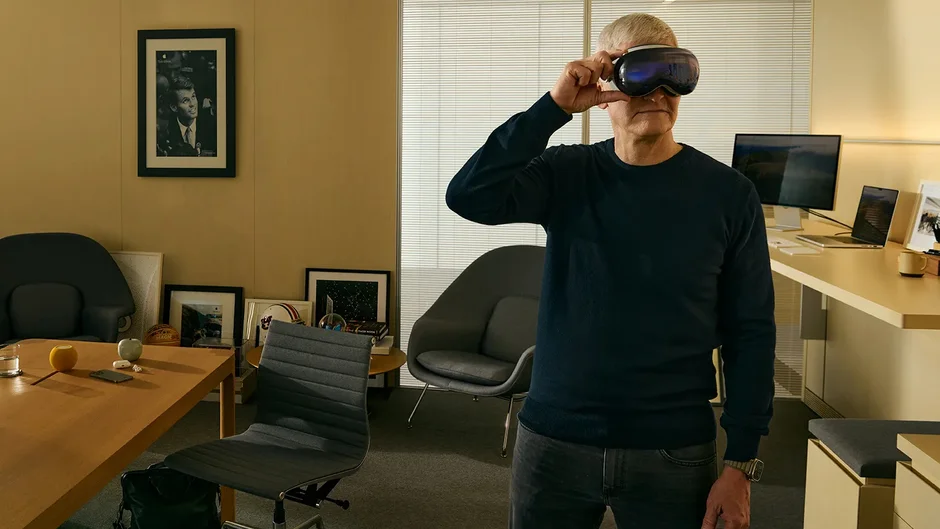
When Apple steps onto a new stage, the world usually pauses. This is the company that turned MP3 players into cultural icons, made smartphones indispensable, and redefined wearables with the Apple Watch. So when it unveiled the Apple Vision Pro, expectations weren’t just high—they were historic.
And yet, somewhere between ambition and execution, Apple may have stumbled. Not just a small misstep, but something far more significant—a generational fumble that could shape how we remember this era of computing.
Let’s unpack what went wrong, why it matters, and whether this “failure” is truly the end of the story.
The Promise: A New Computing Paradigm
Apple didn’t position the Vision Pro as just another gadget. It called it a spatial computer—a device meant to replace or at least redefine how we interact with digital content.
On paper, it sounded revolutionary:
- Ultra-high-resolution micro-OLED displays
- Eye and hand tracking instead of controllers
- Seamless blend of augmented and virtual reality
- Integration with the Apple ecosystem
It wasn’t just competing with VR headsets; it was trying to leapfrog them entirely.
The pitch was bold: this is the future of computing.
But bold ideas demand equally bold execution—and that’s where cracks began to show.
The Price Problem: Innovation Meets Reality
Let’s address the elephant in the room.
The Vision Pro launched at a price point that placed it far beyond the reach of average consumers. At a cost comparable to a high-end laptop—or even more—it instantly limited its audience to early adopters and developers.
Apple has sold expensive products before. But those products—like the iPhone—offered immediate, clear value. You could justify the cost because the use cases were obvious and daily.
With the Vision Pro, that clarity was missing.
People didn’t ask, “How can I afford this?”
They asked, “Why do I need this?”
That’s a dangerous question for any product—especially one trying to define a new category.
The Use Case Gap: Impressive, But Not Essential
The Vision Pro is undeniably impressive. Watching a movie on a massive virtual screen, multitasking with floating windows, or experiencing immersive environments—it all feels futuristic.
But here’s the problem: most of it feels like a luxury, not a necessity.
- Watching movies? A TV does it cheaper.
- Productivity? A MacBook is more practical.
- Gaming? Dedicated consoles and PCs dominate.
The Vision Pro sits awkwardly between categories, not quite replacing any of them.
Apple has historically succeeded by creating products people didn’t know they needed—until they couldn’t live without them. The Vision Pro hasn’t crossed that threshold.
At least, not yet.
Comfort and Practicality: The Human Factor
Technology doesn’t exist in a vacuum—it lives on our bodies, in our hands, and in our daily routines.
And wearing a headset for extended periods? That’s still a challenge.
Even with Apple’s premium design:
- The device is bulky
- It can feel heavy over time
- Battery limitations restrict long sessions
Compare that to the simplicity of pulling out a phone or opening a laptop. Convenience often beats innovation, and the Vision Pro struggles here.
It’s not just about what the device can do—it’s about how naturally it fits into life. And right now, it feels more like an experience than a habit.
The Ecosystem Dilemma
Apple’s biggest strength has always been its ecosystem. iPhone, Mac, iPad, Apple Watch—they all work together seamlessly.
The Vision Pro was supposed to extend that ecosystem into a new dimension.
But instead of feeling like a natural extension, it feels like a separate island.
Yes, it integrates with Apple devices—but not in a way that makes it indispensable. It doesn’t replace your phone. It doesn’t eliminate your laptop. It doesn’t become your daily driver.
It’s an add-on. And expensive add-ons are hard to justify.
Timing: Too Early or Too Late?
There’s an argument to be made that Apple didn’t fail—it simply arrived at the wrong time.
The world isn’t fully ready for spatial computing:
- Developers are still experimenting
- Content libraries are limited
- Social acceptance of headsets is low
But here’s the twist: Apple is usually perfect at timing.
It didn’t invent the smartphone—but it perfected it when the market was ready.
It didn’t invent smartwatches—but it made them mainstream.
With Vision Pro, it feels like Apple jumped ahead before the foundation was built.
That’s unusual—and risky.
The Competition Factor
While Apple was crafting a premium, futuristic vision, competitors were taking a different route.
Companies in the VR/AR space focused on:
- Lower prices
- Gaming-first experiences
- Gradual adoption
This created a contrast:
- Apple aimed for the future
- Others focused on the present
And right now, the present is where most users live.
The Vision Pro might represent where technology is going—but consumers are still deciding where they are.
The Marketing Narrative: Vision vs Reality
Apple is known for storytelling. Its product launches feel like cultural events.
But the Vision Pro’s narrative leaned heavily on vision—literally and figuratively.
The messaging was aspirational:
- Work in infinite space
- Relive memories in 3D
- Blend digital and physical worlds
It sounded incredible. But for many users, the real experience didn’t fully match the dream.
That gap between expectation and reality can be damaging—especially for a company built on trust and consistency.
Is It Really a “Fumble”?
Calling the Vision Pro a failure might be premature.
Apple has a history of playing the long game:
- The first iPhone lacked apps and basic features
- The first Apple Watch was slow and limited
- Even the iPad took time to find its place
The Vision Pro could follow a similar trajectory.
This first version might not be the breakthrough—but it could be the foundation.
Still, the difference here is scale. The expectations were higher, the price steeper, and the competition more mature.
That’s why this feels less like a small misstep and more like a generational stumble.
The Bigger Question: What Comes Next?
The real story isn’t about what the Vision Pro is—it’s about what it becomes.
For Apple to recover and succeed in this space, a few things need to happen:
1. A More Accessible Version
A lower-priced model could bring spatial computing to a wider audience.
2. Killer Use Cases
Apple needs to answer the question: Why does this matter in daily life?
3. Developer Ecosystem Growth
More apps, more creativity, more reasons to use the device.
4. Improved Comfort and Design
Lighter, more practical hardware will be key.
If Apple can deliver on these, the Vision Pro might still become what it was meant to be.