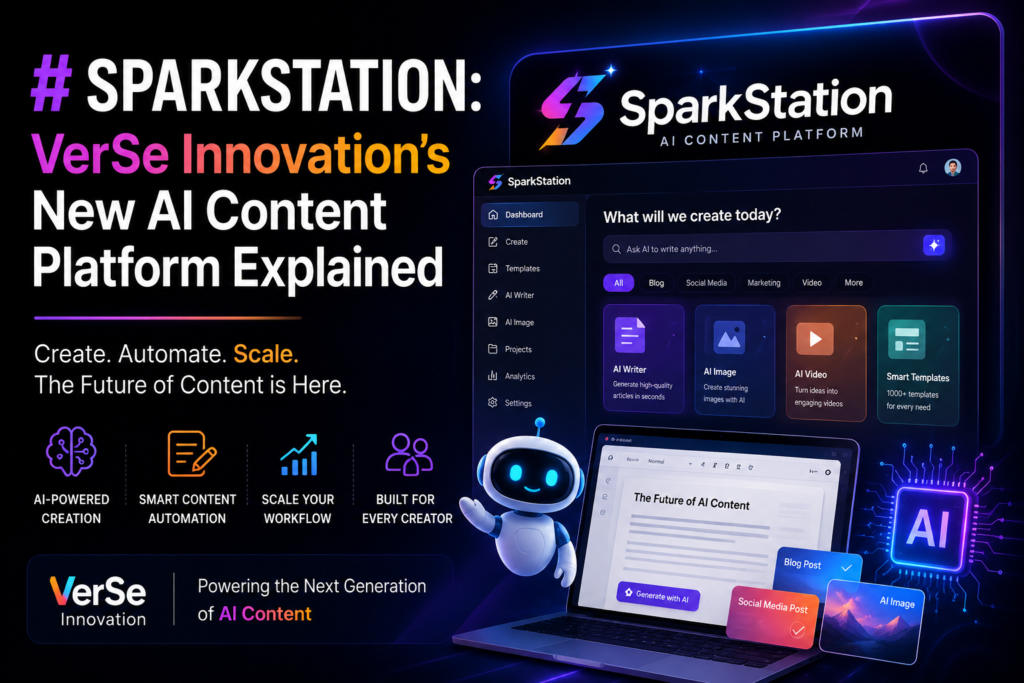
Anyone who’s ever tried to make a professional-looking brand video knows the drill — you write a script, wait weeks for a production house to get back to you, book a shoot, deal with reshoots, hand it off to an editor, and somehow still end up over budget, which is honestly part of why so many good ideas never make it past the pitch stage. So when VerSe Innovation, the company behind Dailyhunt and Josh, unveiled SparkStation at Film Expo 2026, it wasn’t just another AI video tool joining an already crowded field; it was pitched as something bigger — an “AI Content Operating System” meant to handle the entire journey from a raw idea to a finished, distribution-ready video, all inside one workflow, rather than forcing teams to stitch together five different apps to get one project done. This article breaks down what SparkStation actually does, who it’s realistically built for, and what to know before relying on it for real production work, written for filmmakers, brand marketers, and creators trying to figure out whether this is worth their attention or just another launch announcement. A few things worth knowing upfront: SparkStation claims it can cut a 60-second brand film’s cost by around 90%, it’s rolling out in three separate stages between August and November 2026, and it’s already been running internally at VerSe for over six months, generating real revenue, before this public unveiling even happened.
Important Facts About Choosing an AI Content Production Platform Like SparkStation
Before relying on SparkStation for real production work, a few things are worth checking carefully. Consistency across shots is the real test — plenty of AI video tools can generate one great clip, but keeping the same face, wardrobe, and location consistent across an entire production is where most tools quietly fall apart. SparkStation’s model-agnostic approach, which picks the best AI model for each specific task rather than forcing everything through one system, is a direct answer to that problem. Export compatibility matters more than people expect — SparkStation exports into Premiere, Final Cut, and DaVinci Resolve, so it slots into existing post-production workflows instead of forcing a painful manual workaround. Watch for vague cost-saving claims versus specific numbers — the roughly 90% cost reduction SparkStation is advertising is a concrete figure worth holding it to, rather than taking marketing language at face value. Finally, check where the platform sits in its rollout at the time you’re evaluating it — beta, general availability, and enterprise API are three very different levels of stability, so match your expectations and your project’s stakes to the actual maturity stage before committing.
SparkStation’s Core Capabilities
1. Full Pipeline in One Workflow SparkStation covers the entire production journey — scripting, storyboards, casting, locations, costumes, and multi-angle shots — inside a single platform, rather than requiring separate tools for each stage. That means a filmmaker or brand team can move from a rough idea to a shootable plan without switching apps or losing context between steps.
2. Model-Agnostic AI Layer Instead of relying on one AI model for everything, SparkStation automatically selects the most suitable model for each specific creative task. This matters because different AI models are genuinely better at different things — one might handle dialogue generation well, another might be stronger at rendering consistent faces — and SparkStation’s job is to pick the right tool for each job automatically.
3. Cross-Scene Consistency One of the biggest weaknesses in AI-generated video has always been continuity — a character’s face or outfit subtly shifting from one clip to the next. SparkStation is specifically built to maintain consistency in face, expression, wardrobe, location, and props throughout a production, which is what separates a usable finished product from a disjointed AI demo reel.
4. Multi-Language, Localized Output The platform supports more than 60 languages, including localized lip movements that match the spoken language rather than a generic mouth animation. For brands and creators working across multiple markets, this removes one of the most tedious parts of localization — manually re-syncing lip movement for every dubbed version.
5. Built for Three Distinct Users SparkStation is designed with filmmakers, brands/agencies, and individual creators in mind, each getting tools suited to their scale. Filmmakers get story development, casting, and full editing/rendering tools with direct export to major editing software; brands get tools for image, video, UGC, and localized campaign variants at volume; creators get templates and studio-quality output through a credit system.
Frequently Asked Questions
Q1: What is SparkStation? SparkStation is an AI-powered content production platform launched by VerSe Innovation, the parent company of Dailyhunt and Josh. It’s designed as a full “Content Operating System” that covers scripting, casting, shooting, editing, and distribution formatting all within one workflow.
Q2: How much does SparkStation cost? Pricing follows three models: a credit-based system for individual creators, seat-based SaaS pricing for studios and brands, and enterprise licensing with API access for larger organizations. Exact figures for each tier weren’t fully detailed at launch, so specific costs are best confirmed directly through the platform.
Q3: When is SparkStation launching? The rollout happens in three stages — beta access from August 29, 2026, general availability starting October 1, 2026, and an enterprise API launching November 1, 2026. Each stage is aimed at progressively wider and more demanding use cases.
Q4: Who is SparkStation built for? It targets three main groups: filmmakers and production houses, brands and agencies, and individual creators or influencers. Each group gets tailored tools, from full cinematic production features for filmmakers to templates and credit-based access for creators.
Q5: How does SparkStation keep content consistent across scenes? It uses a model-agnostic AI layer that selects the most suitable AI model for each specific task, while maintaining consistency in face, expression, wardrobe, location, and props throughout a production. This is meant to solve one of the most common weaknesses in AI-generated video — content that looks disjointed from one clip to the next.
Conclusion
SparkStation represents a genuinely different bet than most AI content tools on the market — instead of solving one narrow piece of production, it’s trying to own the entire pipeline from first idea to final export. Whether that ambition pays off in practice will depend on how well it performs once it’s out of VerSe’s hands and into the workflows of real filmmakers, brands, and creators, but the underlying numbers — a claimed 90% cost reduction and a shift from weeks to about a day for a finished brand film — are a serious enough claim to keep an eye on. The main things to weigh before adopting it are your team’s existing workflow, which pricing tier actually matches how you work, and whether you’re comfortable being an early adopter during beta or would rather wait for a more battle-tested release. Either way, SparkStation is a clear signal of where content production is heading, and it’s worth watching closely as it moves through its rollout over the next few months.