AGIBOT’s CES 2026 Moment: Humanoid Robots Are Finally Stepping Into the Real World
Let’s be honest—humanoid robots have felt like they’ve been “almost here” for years.
We’ve seen them in flashy demos, viral videos, and carefully controlled lab environments. But in everyday life? Not so much. For most of us, they’ve remained more concept than reality.
That’s exactly what makes AGIBOT’s presence at CES 2026 feel different.
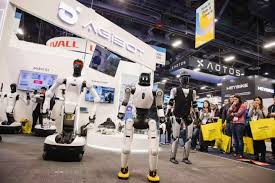
This isn’t another polished prototype meant to impress from behind a barrier. AGIBOT is making a clear statement: humanoid robots are ready to leave the lab—and actually start working among us. With the launch of multiple robot series tailored for real-world use, they’re not testing the waters. They’re diving in.
And their approach is refreshingly practical: it’s not about building one perfect robot—it’s about building the right robot for each job.
Meet the Lineup
The A2 Series: A Robot You Can Actually Work With
The A2 feels like AGIBOT’s answer to a simple question: What would a robot look like if it were truly designed to work alongside humans?
Standing at 5’6” and built with human-like proportions, it’s meant to blend in—not intimidate. But what really stands out isn’t its appearance—it’s how naturally it moves and interacts.
With up to 40 degrees of freedom, the A2 isn’t stiff or mechanical. It can perform smooth, coordinated movements—whether that’s handling delicate tasks or even something expressive like dancing or playing music.
Then there’s the interaction layer. This is where things get interesting.
The A2 can hold conversations using a multilingual language model, but it goes beyond just answering questions. It communicates. Its face display shows a range of expressions, backed by a wide library of gestures, making interactions feel surprisingly human.
For businesses thinking about customer-facing roles, hospitality, or collaborative environments, this isn’t just a machine—it’s a presence.
The X2 Series: Built for Builders
If the A2 is ready to go out of the box, the X2 is where creativity takes over.
Smaller, lighter, and fully modular, the X2 is clearly designed with developers, researchers, and tinkerers in mind. It’s the kind of platform you don’t just use—you build on.
AGIBOT is opening things up with APIs that let you control everything from movement to expressions to lighting. On top of that, the hardware itself is customizable. Need a different kind of hand for a specific task? Swap it out.
What makes this especially powerful is that it doesn’t compromise on capability. The X2 comes equipped with advanced sensors like multiple cameras and 3D LiDAR, giving you the tools to experiment, prototype, and deploy real solutions.
For anyone frustrated by closed ecosystems or limited robotics platforms, this is a big deal. It’s not just a robot—it’s a toolkit.
The G2 Series: Built to Do the Heavy Lifting
Then there’s the G2—the workhorse of the lineup.
This is where AGIBOT shifts from “helpful assistant” to “serious operator.” Designed for industrial and demanding environments, the G2 is built with durability and performance in mind.
At two meters tall and equipped with automotive-grade components, it’s made to handle real workloads. It can carry meaningful payloads and operate in environments where precision matters just as much as strength.
And surprisingly, it’s not clumsy.
With 26 degrees of freedom and highly precise hand control, the G2 can perform detailed tasks while still managing heavier operations. Its ability to detect touch and avoid collisions adds a layer of safety that’s critical in shared workspaces.
In short, it’s not just powerful—it’s controlled, aware, and adaptable.
What Connects Them All: Shared Intelligence
Here’s where AGIBOT’s strategy really clicks.
All these robots—despite their different roles—are powered by a unified AI system that combines vision, language, and action. That means skills aren’t locked to one machine.
If one robot learns how to navigate a complex environment or perform a task efficiently, that knowledge can be shared across the entire lineup.
Why does this matter?
Because it solves one of the biggest challenges in robotics: scalability. Instead of retraining every robot from scratch, improvements can spread across the network. Faster learning, better performance, and more consistent results.
For businesses, that translates directly into lower friction and higher reliability.
The Bigger Picture: This Is Deployment, Not Experimentation
What sets AGIBOT apart right now isn’t just the technology—it’s the timing.
They’re not showing up with promises. They already have thousands of humanoid robots in use across industries like manufacturing, logistics, education, and entertainment. CES 2026 isn’t their debut—it’s their expansion.
And that changes the conversation.
We’re no longer asking if humanoid robots will become part of everyday life. The real questions now are:
- Where will they fit first?
- How will they change workflows?
- And how quickly will we adapt?
AGIBOT’s answer is clear: the transition has already started.
Final Thoughts
For years, humanoid robots felt like a preview of the future—impressive, but distant.
That distance is shrinking fast.
AGIBOT’s lineup shows what happens when robotics moves beyond experimentation and into real-world application. These aren’t fragile showpieces—they’re designed to work, adapt, and integrate into environments we recognize.
The shift is subtle, but important.
The robots aren’t behind glass anymore.
They’re stepping into the world—and this time, they’re here to stay.